
Introduction
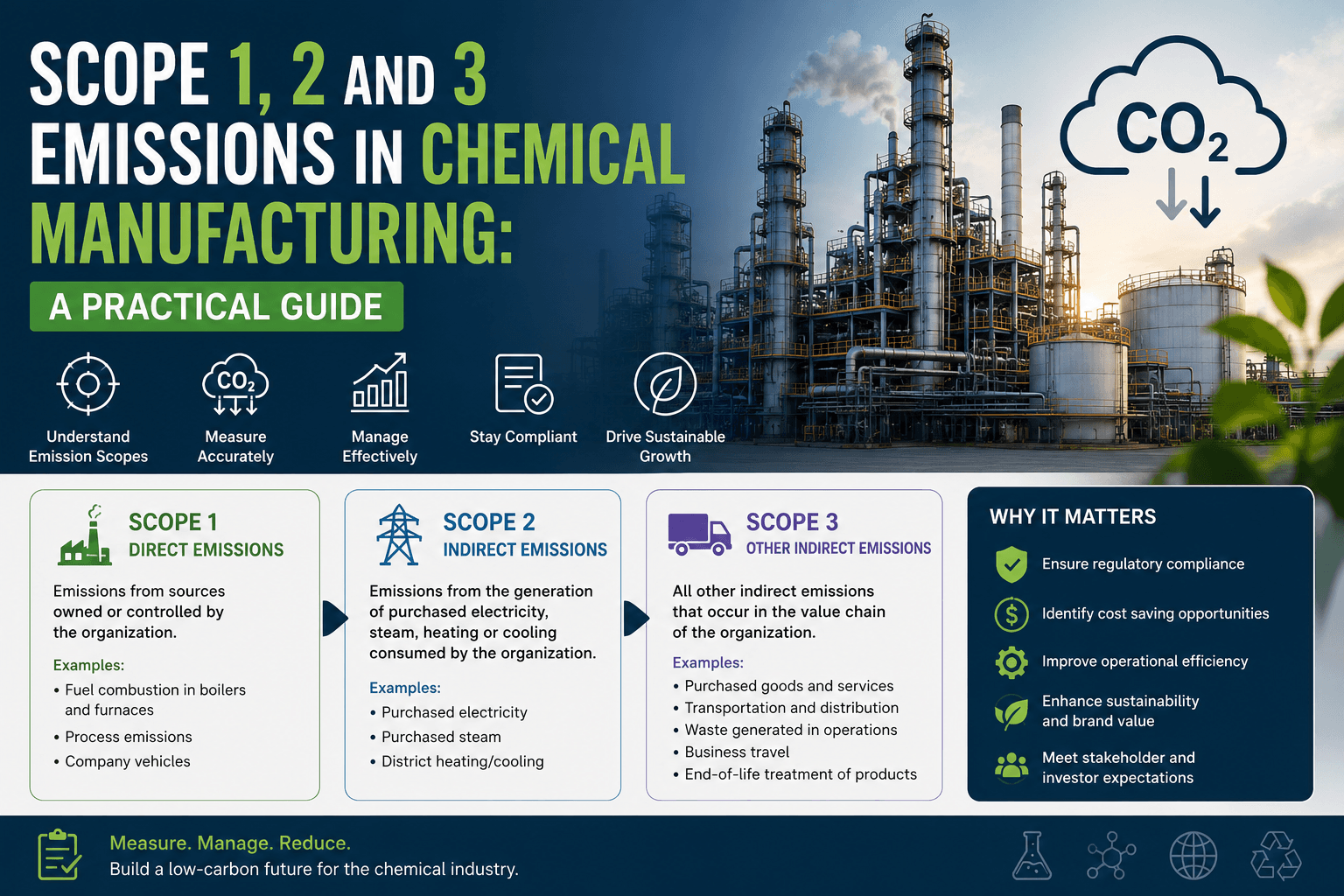
The chemical industry is a significant contributor to global greenhouse gas (GHG) emissions, yet it also holds the potential to lead in low‑carbon innovation. To create a credible sustainability roadmap, manufacturers must first quantify emissions across the three scopes defined by the Greenhouse Gas Protocol: Scope 1 (direct emissions), Scope 2 (indirect emissions from purchased electricity), and Scope 3 (all other indirect emissions). This guide explains each scope in the context of chemical production and presents actionable steps for measurement, reduction, and reporting.
Scope 1: Direct Emissions From Operations
What It Covers
Scope 1 includes all GHG emissions that arise directly from sources owned or controlled by the company. In a chemical plant, these are typically:
- Combustion of fossil fuels in boilers, furnaces and generators
- Process-related releases (e.g., vented gases, fugitive leaks)
- On‑site transportation and mobile equipment
- Use of refrigerants and solvents in process units
Measurement Best Practices
- Install real‑time combustion analyzers on key burners to capture CO₂, CH₄ and CO.
- Use mass balance and heat balance calculations for process‑related emissions.
- Conduct regular fugitive leak inventories with ultrasonic detectors and infrared cameras.
- Apply the IPCC Tier 1 or Tier 2 methodology based on data quality.
Reduction Strategies
- Upgrade to high‑efficiency combustion systems and retrofit burners.
- Implement closed‑loop solvent recovery and recycle steam.
- Replace hydrocarbons with low‑carbon alternatives where feasible.
- Introduce carbon capture, utilization and storage (CCUS) in high‑intensity units.
Scope 2: Indirect Emissions From Purchased Electricity
What It Covers
Scope 2 captures emissions from the generation of electricity, heat or steam purchased by the company. In chemical manufacturing, electrical demand often supports process pumps, compressors, control systems and facility lighting.
Measurement Best Practices
- Collect annual utility bills and verify kilowatt‑hour consumption.
- Use the grid emission factor provided by the utility or the national average.
- For high‑value customers, consider purchasing renewable energy certificates (RECs) or entering into power purchase agreements (PPAs).
Reduction Strategies
- Integrate on‑site renewable generation (solar PV, wind, biogas).
- Upgrade to energy‑efficient motors, drives and control logic.
- Implement demand‑side management and load shifting during peak periods.
- Adopt smart building systems for dynamic lighting and HVAC control.
Scope 3: All Other Indirect Emissions
What It Covers
Scope 3 includes emissions that are not captured in Scope 1 or 2 but are still a consequence of the company’s activities. For chemical manufacturers, key Scope 3 categories are:
- Purchased raw materials and feedstocks
- Transportation of chemicals to customers and suppliers
- Use of the chemical products (e.g., combustion, industrial processes)
- End‑of‑life treatment of products and packaging
- Business travel and employee commuting
Measurement Best Practices
- Collaborate with suppliers to obtain life‑cycle inventory (LCI) data.
- Use activity data (tons shipped, km traveled) combined with emission factors from the GHG Protocol or EPA databases.
- Leverage software platforms that aggregate Scope 3 data across the value chain.
- Apply the GHG Protocol’s 15 Scope 3 categories, prioritizing those with the highest impact.
Reduction Strategies
- Engage suppliers to adopt greener feedstocks and improve their own emission profiles.
- Optimize logistics: consolidate shipments, use low‑emission transport modes, and route planning.
- Develop product lines with lower end‑of‑life emissions (e.g., biodegradable additives).
- Encourage customers to use high‑efficiency equipment and provide technical support.
- Offer incentives for product return and recycling programs.
Integrating the Scopes Into a Unified Strategy
To achieve meaningful emissions reductions, companies must:
- Set a science‑based target for each scope, aligned with the Paris Agreement.
- Adopt a common accounting framework (GHG Protocol) and reporting standard (CDP, SBTi).
- Invest in data management systems that consolidate Scope 1, 2 and 3 metrics.
- Include emissions targets in executive dashboards and KPI reviews.
- Communicate progress transparently to investors, regulators and customers.
Conclusion
Scope 1, 2 and 3 emissions each present unique challenges and opportunities for chemical manufacturers. By systematically measuring, reporting and reducing emissions across all scopes, companies can not only meet regulatory demands but also unlock cost savings, enhance brand reputation and secure a competitive edge in a carbon‑conscious market.