Indonesia’s Chemical Industry Vision
Indonesia’s long-term industrial strategy focuses on moving from a raw material exporter to a value-added manufacturing hub. The chemical industry plays a central role in this transformation because it supports key downstream sectors such as:
Plastics and packaging
Automotive manufacturing
Construction materials
Agriculture and fertilizers
Electronics and industrial goods
The government’s broader industrial policies emphasize:
Increasing domestic value addition
Expanding petrochemical capacity
Reducing import dependency in strategic materials
Attracting foreign direct investment (FDI) into downstream processing
However, achieving full self-sufficiency in chemicals is complex due to technology gaps and the diversity of chemical product categories.
Strong Areas of Domestic Chemical Production
Indonesia has made significant progress in several core chemical segments, particularly those linked to its natural resources.
1. Petrochemicals and Basic Polymers
Indonesia has expanded production of:
Polyethylene (PE)
Polypropylene (PP)
Basic petrochemical feedstocks
These are supported by refining and petrochemical integration projects that aim to strengthen domestic supply for plastics and packaging industries.
2. Resource-Based Chemicals
Indonesia has a strong advantage in chemicals derived from natural resources:
Palm oil-based chemicals (surfactants, oleochemicals, biodiesel inputs)
Nickel-based processing chemicals linked to battery supply chains
Fertilizer production supported by domestic gas and mineral resources
These segments are central to Indonesia’s push toward value-added exports.
3. Fertilizers and Agrochemicals (Partial Strength)
Indonesia has domestic fertilizer production capacity, particularly for:
Urea
Ammonia-based products
Basic crop nutrients
However, it still imports many advanced crop protection chemicals and specialty formulations.
Where Indonesia Still Depends on Imports
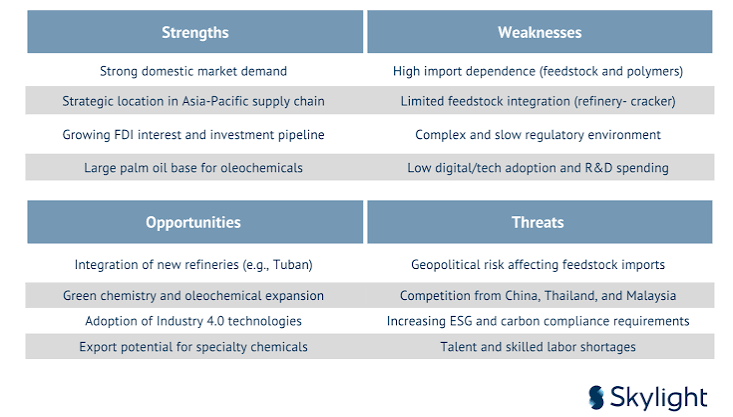
Despite strong progress, Indonesia remains highly import-dependent in several critical chemical categories.
1. Specialty Chemicals
These include:
Performance additives
High-end coatings
Adhesives and sealants
Electronic-grade chemicals
These products require advanced formulation expertise and R&D capabilities that are still developing locally.
2. Fine and Performance Chemicals
Industries such as pharmaceuticals, electronics, and high-tech manufacturing rely on imported:
Active chemical ingredients
High-purity solvents
Precision chemical formulations
These are difficult to substitute with domestic production in the short term.
3. Industrial Process Chemicals
Many manufacturing sectors import:
Catalysts
Processing aids
High-performance industrial inputs
These are often sourced from established chemical producers in China, Japan, South Korea, Europe, and the US.
4. Intermediate Chemicals
Even when final products are made domestically, Indonesia often imports intermediate chemicals used in:
Plastics processing
Textile production
Paints and coatings
Why Import Dependence Still Exists
Several structural factors explain Indonesia’s continued reliance on imports:
1. Technology and R&D Gaps
Specialty chemical production requires advanced formulation knowledge, which is still developing locally.
2. Capital Intensity
Many chemical plants require high upfront investment, long payback periods, and complex infrastructure.
3. Supply Chain Complexity
Certain inputs depend on global supply chains that are not yet fully replicated domestically.
4. Quality and Certification Requirements
Industries like electronics and pharmaceuticals require strict international standards, which imported chemicals often already meet.
The Role of Foreign Investment
Foreign direct investment is playing a major role in bridging Indonesia’s production gap. International chemical companies are investing in:
Petrochemical complexes
Specialty chemical blending facilities
Joint ventures with local manufacturers
Downstream processing plants near industrial zones
This helps transfer technology while also increasing local production capacity over time.
Impact on B2B Chemical Suppliers
Indonesia’s mixed production-import structure creates a highly dynamic market for B2B suppliers.
Opportunities for Local Manufacturers:
Strong demand for domestically produced polymers and fertilizers
Government support for import substitution
Expanding downstream manufacturing base
Opportunities for International Suppliers:
Continued demand for specialty chemicals
High-value industrial inputs with limited local alternatives
Long-term supply contracts with Indonesian manufacturers
Growing need for technical-grade imports in advanced industries
Distribution and Market Structure
Indonesia’s chemical distribution system is also evolving. It typically involves:
Importers and trading companies
Industrial distributors
Local blending and repackaging units
Direct procurement by large manufacturers
Digital procurement platforms are beginning to streamline this structure, improving transparency and reducing sourcing friction for buyers.
Strategic Shift: Import Substitution with Selective Dependence
Indonesia is not aiming for full chemical self-sufficiency. Instead, it is following a selective import substitution strategy:
Increase domestic production in bulk chemicals
Maintain imports for advanced specialty chemicals
Attract foreign investment to upgrade capabilities
Focus on value-added downstream industries
This balanced approach is designed to improve resilience while still integrating into global supply chains.
Future Outlook
Over the next decade, Indonesia’s chemical industry is expected to:
Expand petrochemical and polymer production capacity
Strengthen its role in EV battery material supply chains
Reduce import dependency in basic chemicals
Continue relying on imports for high-end specialty chemicals
Become a stronger regional production hub within ASEAN
Conclusion
Indonesia’s chemical sector reflects a realistic and transitional industrial strategy. While domestic production is growing rapidly in basic and resource-based chemicals, imports remain essential for specialty and high-performance segments.
For B2B suppliers, this creates a dual opportunity: competition in commodity chemicals, and strong demand for imported specialty products. For Indonesia, the challenge and opportunity lie in balancing import dependence with long-term industrial upgrading.
As investment continues and technology transfer accelerates, Indonesia is likely to strengthen its position as both a producer and importer within the global chemical ecosystem.